


How to Verify Diffuser Lab Testing in 2026
H
o
w
t
o
V
e
r
i
f
y
D
i
f
f
u
s
e
r
L
a
b
T
e
s
t
i
n
g
i
n
2
0
2
6
Table of Contents
- Why Diffuser Lab Testing Matters for Your Safety
- What to Look for in a Diffuser Certificate of Analysis
- How to Read a Certificate of Analysis: A Step-by-Step Walkthrough
- Batch Testing for Diffusers: What It Is and Why It Matters
- How to Verify a Laboratory Report Is Authentic
- Common Mistakes When Reviewing Diffuser Lab Testing
- Conclusion
- Frequently Asked Questions
Last Updated: October 12, 2026
Why Diffuser Lab Testing Matters for Your Safety
Inhaling anything means you deserve proof of what's inside it. That's the core of how to verify diffuser lab testing: you check the paperwork, confirm the lab, and read the numbers before you trust a device.
At NTRL Diffuser, we treat this as a baseline, not a bonus. Every batch we make goes through independent testing before it reaches you.
Here's the problem. The word "lab-tested" appears on almost every wellness product now. It has no legal weight on its own. Anyone can print it.
So the real skill isn't finding a product that claims testing.
That's what this guide covers.
What to Look for in a Diffuser Certificate of Analysis
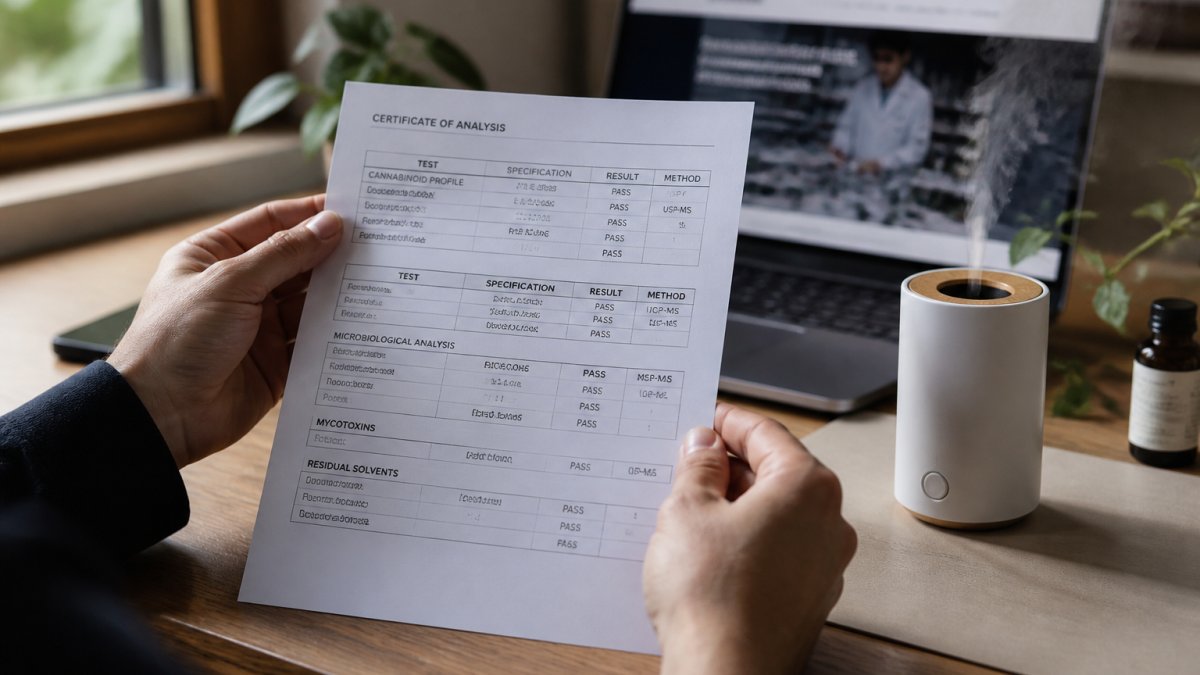
A diffuser certificate of analysis is a document from a lab that lists what was tested in a specific batch and what the results were. It is the single most important piece of proof a brand can give you.
Key Sections of a COA
Most certificates follow a similar layout. Look for these parts:
- Batch or lot number that matches your device
- Lab name and contact details
- Test methods used, such as gas chromatography
- Results, with pass or fail values
- Date of testing and report issue date
- Signature from a qualified analyst
Red Flags on a COA
Some reports look official but fall apart under a closer look. Watch for:
- No batch number, or a number that doesn't match your product
- Missing lab name or a lab you can't find online
- Results with no units or no limits
- A report that's been clearly edited or cropped
- "Pass" written with no actual measured values
If any of these show up, treat the claim as unproven.
How to Read a Certificate of Analysis: A Step-by-Step Walkthrough
Reading a COA takes about five minutes once you know the flow. Here's how we do it, step by step.
- Find the batch number on the report and on your device or packaging.
- Confirm they match exactly. One digit off means it's the wrong batch.
- Check the lab name and search for it online.
- Look at the test methods listed, like GC-MS or GC-FID.
- Read the results table and check the units.
- Note the test date and make sure it's recent.
- Look for a signature from the analyst.
Match the Batch Number
The batch number is the link between a test and a physical product. Without a match, the report proves nothing about your device.
Interpret Test Results
Results should show measured values, not just a checkmark. A purity result, for example, should read as a number with a unit. If a report only says "pass" with no figure, ask why.
Batch Testing for Diffusers: What It Is and Why It Matters
Batch testing for diffusers means testing a sample from each production run, not just one early prototype.
This is where a lot of brands cut corners. They test once, then reuse that report for years.
A proper batch report ties a specific production lot to a specific set of results. That is the only way to know what is actually in the device you are holding.
Match the Test to the Question You Are Asking
No single test answers every question. The most common mistake readers make is treating one GC-MS report as proof of purity, safety, and identity all at once. It is not. Here is how to map the concern to the test:
| What you want to know | Test that addresses it | What it cannot tell you |
|---|---|---|
| Is the oil the species on the label? | GC-MS with a reference library match | Whether the oil is diluted or adulterated |
| Is the oil diluted or cut with a carrier? | GC-FID with quantification, plus chiral GC for some cases | Whether the carrier is safe to inhale |
| Are there synthetic aroma compounds? | GC-MS plus retention index comparison against authentic standards | Whether natural compounds are present at safe levels |
| Are there heavy metals? | ICP-MS | Anything about the organic composition |
| Are there pesticide residues? | LC-MS/MS or GC-MS/MS with a multi-residue panel | Whether the method covers every possible pesticide |
| Is the product safe to inhale? | No single lab test answers this | Toxicology, formulation, and use-pattern data are also needed |
That last row is the one brands rarely say out loud. A clean chromatogram is not a safety certificate. It is one input.
What a Diffuser-Specific Report Should Include
Diffuser oils and blends are not the same as a single essential oil. A blend may contain carrier oils, fixatives, or synthetic aroma materials, and the report should reflect that:
- Identity of each declared component, not just the dominant peak
- Quantified percentages for major constituents, with units
- Carrier or diluent identification if the product is pre-diluted
- Contaminant panel results with detection limits stated
- Batch number, production date, and test date that line up with the packaging
If a report shows only a chromatogram image with no peak table, no units, and no method, it is not a report. It is a picture.
Why Batch-Level Testing Beats One-Time Testing
A single test on a prototype tells you what was in that prototype. It says nothing about the unit in your hand. Batch testing closes that gap by tying results to a specific production run.
The Limits of Any Single Test
GC-MS and GC-FID are powerful, but they are not total proof.
A result of "100% pure" on a report usually means the method did not detect a specific set of expected adulterants above a stated limit.
NTRL Diffuser runs independent batch testing and labels exact dosages, so the numbers on the report line up with what is in the product.
How to Verify a Laboratory Report Is Authentic
A polished PDF is easy to fake. Verifying it takes three concrete steps, and each one closes a different loophole.
Step 1: Confirm the Lab Holds Accreditation for the Specific Test
Accreditation is not a single badge. It is a scope, a defined list of tests a lab is approved to run, using defined methods.
In Canada, the main accreditation bodies are the Standards Council of Canada (SCC), which operates the Program for the Accreditation of Laboratories (PALCAN), and the Canadian Association for Laboratory Accreditation (CALA).
To check a lab:
- Go to the relevant accreditation directory and search the lab's legal name, not its marketing name.
- Open the scope document and find the exact test method listed on your report, for example, a specific GC-MS method for volatile organic compounds.
- Confirm the method on the report matches a method inside the accredited scope. If the report cites a method the lab is not accredited for, the result is outside its approved scope.
A common pattern is a lab that is accredited for water testing but issues reports on essential oil composition.
Step 2: Check Method Validation and Quality Controls
A validated method has been tested to show it produces reliable results for the specific sample type. A method validated for one matrix, say, drinking water, is not automatically valid for a volatile oil blend.
Look on the report for evidence of quality controls:
- Blank samples to show the instrument is not producing false positives
- Reference standards or certified reference materials to confirm the instrument is calibrated
- Duplicate or spike recovery results to show precision and accuracy
- Detection limits (LOD) and quantitation limits (LOQ) so you know the smallest amount the method can reliably measure
If a report lists a result of "not detected" but gives no detection limit, the claim is meaningless. Not detected at 0.01 ppm is a very different statement from not detected at 100 ppm.
Step 3: Contact the Lab Using Independent Contact Details
This is the step almost nobody takes, and it is the most reliable. Call or email the lab using contact details from its own website or the accreditation directory, never the phone number or email printed on the report itself.
Ask three questions:
- Did you test batch [number] for [brand]?
- Was the test performed under your accredited scope?
- Can you send me a copy of the report directly?
A real lab will confirm the batch and send the report. If they have never heard of the brand, or if the report they send differs from the one you were given, you have your answer.
Chain of Custody Matters Too
A result is only as trustworthy as the sample it came from. Ask whether the lab received the sample directly from the manufacturer or through a third party, and whether the sample was sealed and logged on arrival. A lab that accepts an unsealed sample from an unknown courier cannot guarantee the material tested is the material sold.
For broader context on how consumer products sold to the public are expected to be handled, the Canadian government's consumer product safety guidance outlines the general framework.
Common Mistakes When Reviewing Diffuser Lab Testing
Most people make the same few errors. Here's what to avoid.
- Trusting a logo without checking the lab exists
- Skipping the batch number match
- Reading "lab-tested" as a guarantee of safety
- Ignoring the test date
- Assuming one test covers every claim
- Not asking what the test actually measured
The biggest one is treating any single test as total proof. A purity test tells you about purity. It doesn't tell you everything.
NTRL Diffuser publishes batch-level results so you can check the exact device in your hand, not a generic sample.
Conclusion
Verifying diffuser lab testing comes down to three habits: match the batch number, confirm the lab, and read the actual results. Skip any one and the claim stays unproven.
If you want a device where transparency is built in, NTRL Diffuser is worth a look. Every diffuser is zero-nicotine, made with USP-grade plant-based ingredients, and backed by independent batch testing with exact dosage labeling.
Get started with NTRL Diffuser and breathe easier knowing exactly what's inside.
Frequently Asked Questions
How can I verify a diffuser's lab testing?
Request the certificate of analysis (COA) for the specific batch number printed on your product. Check that the COA includes the lab's name, accreditation, test methods, and results. Contact the lab directly to confirm the report is authentic. Look for tests like GC-MS for purity, heavy metals screening, and pesticide residue analysis. A legitimate brand will provide these documents without hesitation.
What should a third-party lab report for a diffuser include?
A complete third-party lab report should list the product name, batch number, test date, and lab credentials. It must show the analytical methods used (such as GC-MS or GC-FID), the specific compounds detected, and whether any contaminants like heavy metals or pesticides were found. The report should also state pass/fail results against established safety limits. Without these details, the report is incomplete.
How do I match a diffuser product to its batch test results?
Find the batch or lot number on the diffuser packaging or device itself. Then request the COA that corresponds to that exact batch number from the brand. The batch number on the COA must match your product exactly. If the brand only provides a generic COA without batch-specific data, that is a red flag. Batch-specific testing ensures the results apply to the actual unit you purchased.
What does USP-grade mean on a diffuser ingredient label?
USP-grade means the ingredient meets the purity and quality standards set by the United States Pharmacopeia, an independent scientific organization. For diffuser ingredients like melatonin or ashwagandha, USP-grade indicates the ingredient has been tested for identity, strength, quality, and purity. It does not guarantee the final product is safe or effective, but it confirms the raw ingredient meets strict manufacturing and testing criteria.
May you also like
